

29 Sep New Guns and Bikes
We have just added another 3 items to our collection over the past couple of weeks.
WWII 8.8cm Flak 18
The Flak 88mm was originally an anti-aircraft gun of WWI, adapted from existing medium calibre weapons, designed to fire at really tight angles- almost vertically from the ground. By 1915the German command had realised that these medium-powered land-based guns were all but useless in fending off airborne attacks- even against the slow-moving balloon based aircraft of the time.
Under the Treaty of Versailles, after losing WWI, the German army were forbidden to buy any new weapons of most types. However, this didn’t stop the Krupp-Bofors partnership begin to make improvements on the existing AA gun designs.
Adding a higher muzzle velocity to the anti-aircraft guns revolutionised the altitudes to which missiles could reach. Coupled with the weight of the projectiles being launched, the flak 88 went from zero to one of the greatest anti-tank guns in WWII. Quite the re-invention.
Further evolutions led to even better performance. Developments of using a single-piece barrel with a length of 56 calibres, a new 88mm design and a longer cartridge with a longer barrel. As early as 1939, Rheinmetall had responded to requests from the Luftwaffe for improvements and innovations. With prototypes ready by early 1941, the new gun fired a 9.4k shell at a muzzle speed of 1000 meters per second. Amazingly, this gave the shell as effective ceiling of 11,300m and a maximum reach of 14,700m.
Efficiency and reliability remained an issue, so the Flak AA Guns were almost exclusively used in Germany.
Pak 36
The Pak 36, full name Panzerabwehrkanone model 1936, was a compact gun, weighing just 327kg, for 45 calibre projectiles. Manned by a crew of three, the gun was able to be manoeuvred quickly. With large wheels and sloping shield, stability was good and the gun gave an exceptional performance against armour ranging from 20mm to 64mm at short range, although best performances were found to be against 22mm armours at 1000m which allowed firing for the crew from a position of relative security.
Production of this model of the Pak 36 ceased in 1941 after a hugely successful military campaign. It was replaced by the more capable PAK-40 and PAK-41, but was available in such large volumes, that it continued to serve nearly all infantry units until the end of 1944, in almost all theatres of war, from Africa, through Europe to Asia.
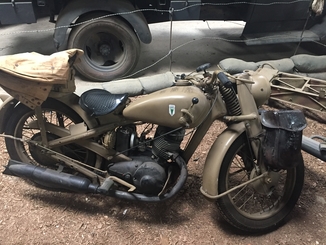
DKW 350 NZ
Our final new recruit is a DKW 235 NZ motorbike. Originally created in 1919 as ‘The Little Marvel’, an incarnation of the original served the German army throughout WWII and continued life as a civilian vehicle through to the middle of the 1950s.
Take a read of this fantastic site to learn more about this cracking bike. Our version does start, if a little delicately, but sits perfectly within the WWII vehicles in the museum.
Our museum is open from April to October, 10am to 4pm and from November to March with prior appointment. Just let us know you are coming if you plan to visit outside of our tank driving season, April to October, so we can make sure we all set for you. Admission is £5 per person over the age of 5 years. If you are visiting to take part in one of our activities or as a passenger, entry to the museum is free, so make sure you plan plenty of time for a look around.
See you soon!
Sorry, the comment form is closed at this time.